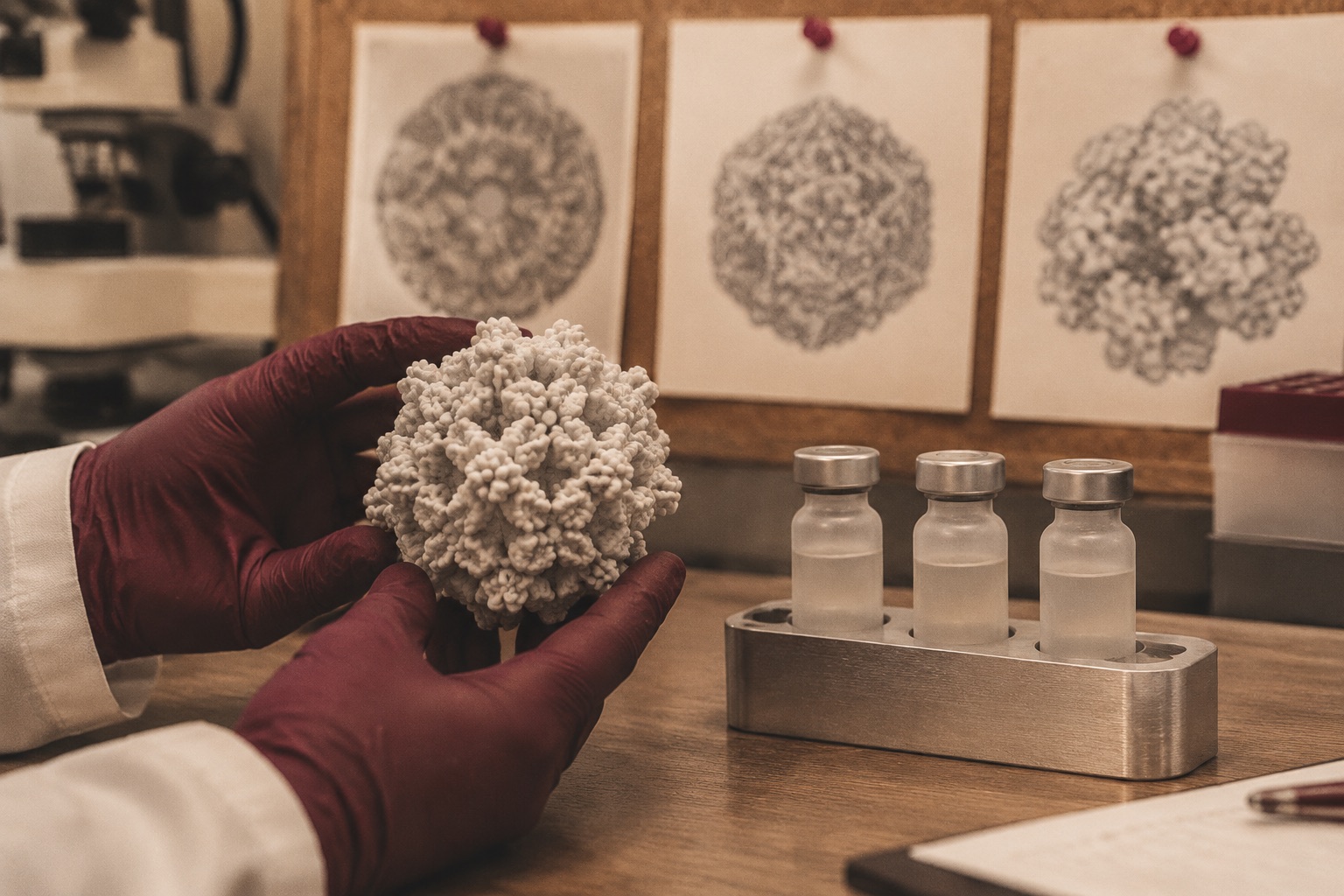
Since PrEPVacc closed in December 2024 with zero efficacy, no Phase IIb or Phase III HIV vaccine efficacy trial has been running anywhere on Earth. What is running instead is an immunological engineering project called sequential germline targeting. Across four human Phase 1 trials (IAVI G001, IAVI G002, IAVI G003, and HVTN 302), investigators have been testing whether mRNA-encoded protein nanoparticles and stabilized envelope trimers can wake rare naive human B cells and shepherd them, one booster at a time, toward broadly neutralizing antibodies (bnAbs). The 2025 clinical readouts in Science and Annals of Internal Medicine mark the furthest point human HIV vaccinology has reached on that path, and expose the dermatologic safety hurdle it now has to clear.
Why HIV requires a multi-step B-cell training sequence
As documented on our six-reason archive and in Record Note No. 003, native HIV-1 Envelope (Env) trimers do not bind the unmutated germline B-cell receptors that eventually give rise to broadly neutralizing antibodies such as VRC01 (which targets the conserved CD4 binding site). Instead, native Env activates abundant non-neutralizing B cells aimed at variable decoy loops. In 2021, the AMP trials proved that passive intravenous infusions of mature VRC01 prevented 75.4% of infections by VRC01-sensitive HIV strains, establishing a human benchmark: if a vaccine can coach human B cells to manufacture VRC01-like antibodies at sufficient titer and breadth, protection is biologically possible.
Coaching those cells requires a sequence of different immunogens. Step 1 (the germline prime) uses a heavily engineered nanoparticle, eOD-GT8 60mer, designed to bind naive VRC01-class precursor B cells carrying specific heavy-chain alleles (IGHV1-2*02 or *04) paired with a short five-amino-acid light-chain CDRL3 loop. In 2022, the Phase 1 IAVI G001 trial (Leggat et al., Science 2022, 10.1126/science.add6502) proved Step 1 in humans using an AS01B-adjuvanted protein subunit vaccine: 97% of vaccine recipients (35 of 36) mounted VRC01-class IgG memory B-cell responses, reaching median frequencies of 0.1% of all blood IgG memory B cells.
What IAVI G002 and G003 proved in Science (May 2025)
A multi-step vaccine schedule built from four or five separate recombinant proteins plus adjuvants would be slow and costly to manufacture globally. The central question of IAVI G002 (NCT05001373, N=60 in the United States) and IAVI G003 (NCT05414786, N=18 in Rwanda and South Africa) was whether Moderna's mRNA-LNP platform could deliver the 60-subunit self-assembling nanoparticle directly inside human cells, and whether a heterologous second immunogen (core-g28v2 60mer mRNA) could drive the next stage of affinity maturation.
Published in Science in May 2025 (Willis et al., Science 2025, 10.1126/science.adr8382), the combined G002 and G003 readout delivered three concrete results:
| Trial & Registry | Cohort & Geography | Immunogen & Platform | Immunological Readout | Dermatologic Safety Signal |
|---|---|---|---|---|
| IAVI G001 (NCT03547245) | N=48 healthy adults United States | eOD-GT8 60mer protein + AS01B adjuvant (prime only) | 97% (35/36) induced VRC01-class bnAb precursors; median 0.1% of blood IgG B cells (Science 2022) | Standard reactogenicity; no chronic urticaria signal |
| IAVI G002 (NCT05001373) | N=60 healthy adults United States | eOD-GT8 60mer mRNA prime (mRNA-1644) + core-g28v2 60mer mRNA boost | High-frequency VRC01-class priming; heterologous boost drove higher SHM, CD4bs affinity & early neutralization with cryo-EM bnAb mimicry (Science 2025) | 18% (11/60) experienced skin reactions (urticaria / pruritus) |
| IAVI G003 (NCT05414786) | N=18 healthy adults Rwanda & South Africa | eOD-GT8 60mer mRNA prime (two doses) | Robust VRC01-class precursor induction and SHM in African cohorts where HIV clade C and A burden is highest (Science 2025) | Well tolerated; lower skin reaction rate than G002 |
| HVTN 302 (NCT05217641) | N=108 healthy adults United States (6 arms) | BG505 MD39.3 Env trimer mRNA (soluble gp140 vs membrane gp151, 100/250 mcg) | Membrane-bound gp151 trimer mRNA elicited autologous tier-2 neutralizing antibodies across 3 doses (2025) | 6.5% (7/108) study-product-related urticaria |
First, mRNA priming worked across continents: both US volunteers in G002 and Rwandan and South African volunteers in G003 generated substantial VRC01-class B-cell precursor frequencies and somatic hypermutation (SHM). Second, in G002, following the eOD-GT8 prime with the heterologous core-g28v2 booster selected for B-cell clones with significantly higher SHM, stronger affinity for more native-like CD4 binding sites, and structural binding modes that cryo-EM confirmed mimic mature VRC01. Third, companion preclinical work in Science Immunology (Science Immunology 2025, 10.1126/sciimmunol.adu7961) demonstrated that four distinct germline-targeting mRNA-LNP immunogens (N332-GT5 gp151, ApexGT5 gp151, eOD-GT8 60mer, and 10E8-GT12 24mer) can be co-administered without inter-epitope B-cell competition.
The HVTN 302 trimer readout and the urticaria question
In parallel, the HIV Vaccine Trials Network reported HVTN 302 (NCT05217641, N=108), testing three doses (0, 2, and 6 months) of 100 mcg or 250 mcg mRNA encoding stabilized HIV-1 BG505 MD39.3 envelope trimers in soluble (gp140) or membrane-bound (gp151 and gp151 CD4KO) forms. Presenting the trimer anchored on the cell membrane elicited autologous tier-2 neutralizing antibodies far more reliably than soluble trimer protein had in earlier trials.
Yet both G002 and HVTN 302 surfaced the same clinical caution: delayed-onset skin reactions. In IAVI G002, 18% of participants experienced skin reactions (primarily urticaria and pruritus); in HVTN 302, 7 of 108 participants (6.5%) developed study-product-related urticaria. None of the events were life-threatening, and most resolved with antihistamines or corticosteroids, but dermatologic reactogenicity at 7 to 18 percent is a central engineering constraint as germline-targeting regimens add a third and fourth booster. While basic science solves that formulation puzzle and shepherds B cells toward heterologous tier-2 breadth, our prevention ledger holds the same bottom line: the vaccine pipeline is in Phase 1 immunology, while twice-yearly lenacapavir and oral PrEP remain the tools that stop HIV acquisition today.
Straight answers
FAQ- Did IAVI G002 or G003 prove that an mRNA HIV vaccine prevents infection?
- No. Both IAVI G002 (N=60 in the United States) and IAVI G003 (N=18 in Rwanda and South Africa) are Phase 1 safety and immunogenicity trials, not efficacy trials. They proved that mRNA-encoded nanoparticles can prime rare VRC01-class B-cell precursors in humans and that a first heterologous booster advances somatic hypermutation and binding affinity.
- Why did 18% of participants in IAVI G002 experience skin reactions?
- In IAVI G002 (Science, May 2025) roughly 18% of recipients developed urticaria (hives) or pruritic skin reactions, echoing the ~7% (7/108) product-related urticaria rate reported in the HVTN 302 trimer mRNA trial. Investigators treat delayed urticaria as a tractable but real safety signal across multi-dose HIV mRNA-LNP regimens that requires dose and formulation refinement.
- Why was running IAVI G003 in Rwanda and South Africa necessary after G001 and G002?
- Germline-targeting vaccines depend on the frequency of specific immunoglobulin heavy-chain alleles (such as IGHV1-2*02 and *04 for VRC01-class antibodies) in the naive B-cell repertoire. IAVI G003 proved that the eOD-GT8 60mer mRNA prime reliably recruits VRC01-class precursors in African volunteers where clade C and A viruses circulate and where an eventual vaccine is needed most.