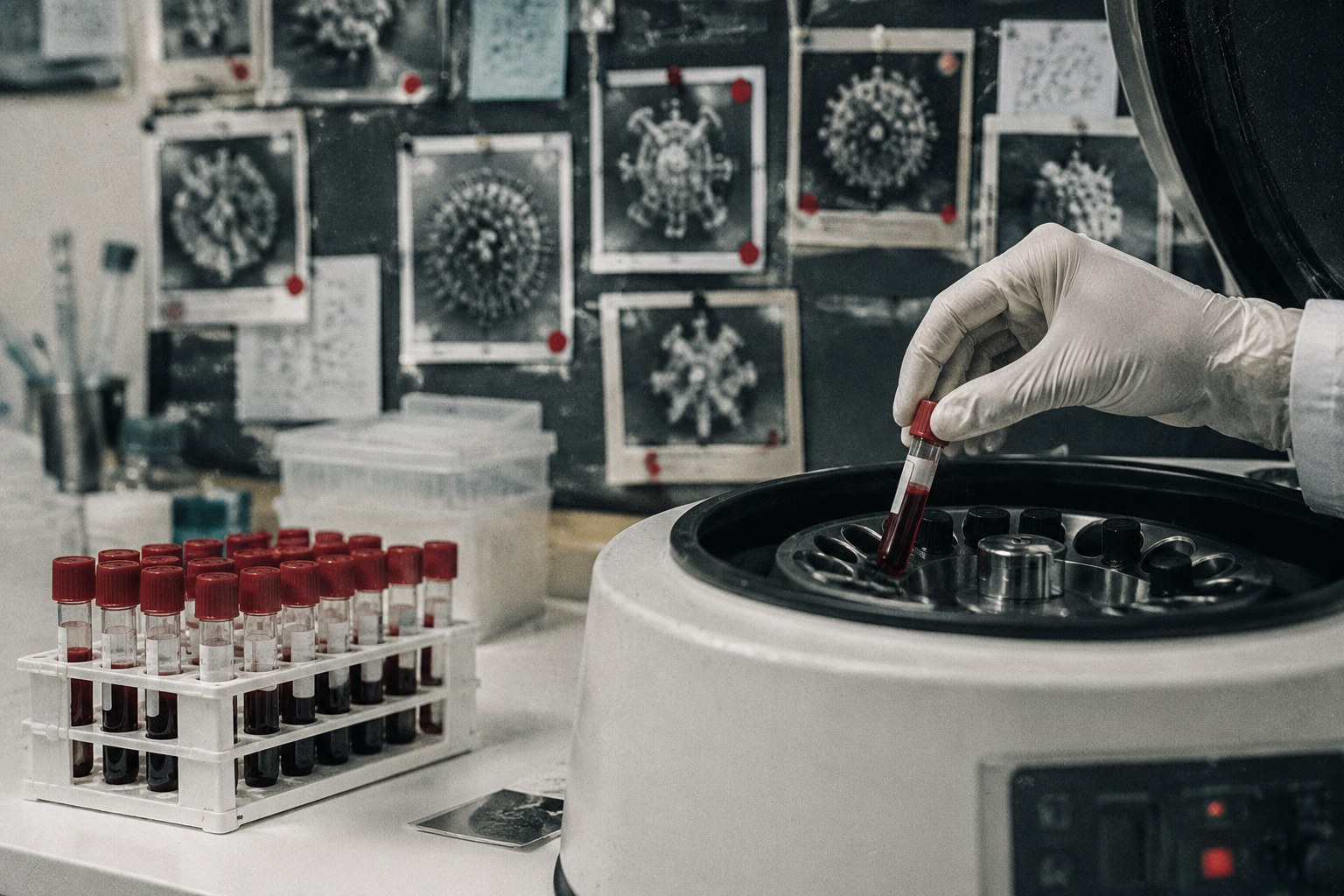
Every vaccine in this archive tried to teach the immune system to aim at HIV's surface. The surface has a habit: its most conspicuous parts vary freely from strain to strain, so the antibodies that respond first go to targets that barely repeat. The useful targets, the conserved machinery and the shielded loops, sit quiet. The immune system's tendency to shout at the loudest antigen is called immunodominance, and it is one reason a 42-year-old promise is still open. At the 26th International AIDS Conference in Rio in July, three teams showed three different ways to stop aiming at decoys. This entry reads all three against the ledger.
1. Delete the decoy: V1-out, 81% of monkeys protected
Dr. Genoveffa Franchini's team at the US National Cancer Institute took the simplest possible route: remove the loudest variable region, the V1 loop, from the immunogens. Twenty-four monkeys were split between full env and V1-deleted env (plus an ALVAC vector and gp120 boost, alum-adjuvanted). Then eleven weekly rectal SHIV challenges. At week 11, 85% of the V1-deleted group remained uninfected versus 30% of the full-env group: about 80% relative efficacy, against a neutralization-resistant virus.
The history under this result is what makes it credible rather than merely loud. RV144 in Thailand, the only human trial ever to show significant efficacy, at 31%, correlated with V2 sensitivity. Uhambo, its South African sequel with a stronger oil-in-water adjuvant, produced more inflammation, more total response, and zero efficacy. The lesson the field drew: a bigger, louder response can be a worse response. The V1-deleted vaccine works, per follow-up studies, by calming mucosal immunity, raising IL-17 and adenosine, making mucosal cells less receptive, rather than by inflaming anything. A monkey-adapted mRNA version in virus-like particles, unpublished as yet, reportedly hit 86%.
The human test is the CLEAR study, 96 volunteers, scheduled to start in 2027, safety-first with an efficacy signal as secondary. Franchini's own caveats are on the record: not all strains may be susceptible to anti-V2 antibodies, and the duration of protection is unknown. Grade B: conference abstracts (OAA3003), peer-reviewed macaque work in Cell Reports Medicine, September 2.
2. Redirect the decoy: teaching gp41 antibodies a better job
The second talk attacked the problem from the antibody's side. Dr. Marta Tarquis Medina of the Wistar Institute described a family of unhelpful antibodies that bind gp41, the stalk of HIV's spike, and noticed that some share amino-acid sequence with PGT121, a potent broadly neutralizing antibody already used in human studies. In mice engineered to produce one such antibody, Ab1718, immunization with a V3-glycan immunogen on a virus-like particle pushed the antibody toward the V3-glycan target. In plain language: they did not go hunting for rare precursor cells. They persuaded common, useless antibodies to change jobs.
Grade C, and honest about it: early preclinical mouse work, presented as a concept (abstract OAA3002). But it reframes germline targeting. If the precursor pool for useful antibodies is larger than assumed, because some decoy antibodies can be retrained, the whole scheduling problem of prime-boost design gets easier.
3. Shortcut to the rare antibodies: CH505 mRNA
The third route is the direct descendant of the germline-targeting program already in this ledger's last entries. Dr. Wilton Williams of Duke reported a macaque trial of an RNA vaccine encoding the CH505 Env, the env of a person whose immune system naturally produced the CH235-family broadly neutralizing antibodies, delivered by lipid nanoparticle. The RNA series induced CH235-like bnAb precursors in 100% of the monkeys. Challenged with ten doses of matched SHIV: three of nine completely protected, and it took nine challenges to infect half the vaccinated animals versus two for the controls.
Complete protection was minority; breadth across the world's strains is unproven; the matched-challenge design flatters the vaccine. All three limits were stated from the podium (abstract OAA3006LB). Still: 100% precursor induction in every dosed animal is the number the germline-targeting line has chased since IAVI G001, and this is the first time an RNA construct has delivered it in macaques.

Put the three side by side and the differences matter less than the shared bet. Franchini's team deletes the loudest target so the quiet ones get heard. Tarquis Medina's team trains antibodies on the decoy's own scaffold until they reach past it. Williams's team skips the line entirely and recruits the rare precursors by name. Three architectures, one conviction: the immune system is not being asked to work harder, it is being asked to look somewhere else.
None of the three is a trial you can enroll in. CLEAR, the V1-deletion follow-on, files its first human data in 2027. Until then the honest status of all of this is the same as it was after every macaque success since 2009: a reason to point the next human trial at the right target. That has been the cheapest thing this field could get right, and the thing it got wrong most often.
Sources
aidsmap conference report, 3 September 2026 · Franchini et al., abstract OAA3003, AIDS 2026, Rio de Janeiro · Tarquis Medina et al., abstract OAA3002, AIDS 2026 · Williams et al., abstract OAA3006LB, AIDS 2026 · V1-deleted env macaque data: Cell Reports Medicine, 2 September 2026, doi 10.1016/j.xcrm.2026.102022.